



Introduction
Studying abroad is a dream for millions of students worldwide. However, one of the biggest obstacles many applicants face is the requirement to submit an English language proficiency test score. Among these tests, IELTS is one of the most commonly requested. The good news is that there are many scholarships without IELTS for international students available today.
Many universities and scholarship providers recognize that students may already have sufficient English skills through previous education. As a result, they offer alternative methods to prove language proficiency. This creates excellent opportunities for students who want to pursue higher education without taking the IELTS exam.
The availability of scholarships without IELTS for international students has increased significantly over the years. Countries such as Germany, Turkey, China, Malaysia, Hungary, and several European nations now provide numerous study abroad opportunities without IELTS requirements. Some institutions accept a medium of instruction certificate, while others conduct online interviews or internal language assessments.
Whether you are planning to pursue a bachelor’s degree, master’s degree, or PhD program, understanding how these scholarships work can help you save time, money, and effort. This guide explains everything you need to know, including eligibility requirements, application steps, benefits, risks, common mistakes, and expert tips for securing international scholarships without IELTS.
What is Scholarships Without IELTS for International Students?
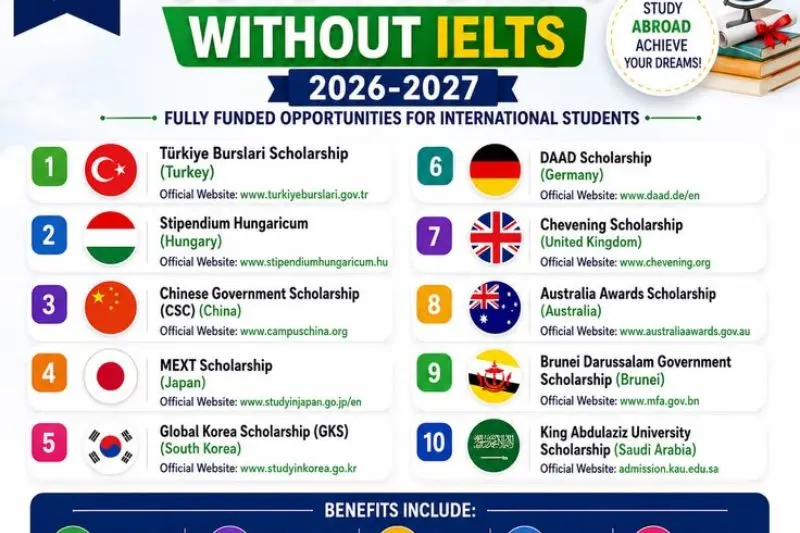
Scholarships without IELTS for international students are financial aid programs that allow foreign students to study abroad without submitting IELTS test scores as part of the admission or scholarship application process.
Instead of IELTS, universities may accept alternative forms of English proficiency verification, such as:
- Medium of Instruction (MOI) certificates
- Previous education completed in English
- University language assessments
- Online interviews
- Alternative English proficiency tests
- Institutional evaluations
These scholarships can be partially funded or fully funded and may cover:
- Tuition fees
- Accommodation expenses
- Monthly stipends
- Health insurance
- Travel costs
- Research grants
Such programs make international education more accessible to students who may not have the resources or opportunity to take IELTS.
Why is Scholarships Without IELTS for International Students Important?
These scholarship opportunities have become increasingly important for students seeking affordable access to global education.
Reduces Financial Burden
Preparing for and taking IELTS can be expensive. Eliminating this requirement saves students additional costs.
Increases Access to Education
Many talented students are unable to take IELTS due to geographical or financial limitations. Scholarships without IELTS create equal opportunities.
Simplifies the Admission Process
Applicants can focus on strengthening other parts of their applications rather than preparing for language exams.
Encourages Global Diversity
Universities benefit from attracting students from diverse educational and cultural backgrounds.
Supports Academic Growth
Students gain access to world-class education, research opportunities, and international career prospects.
Detailed Step-by-Step Guide
Step 1: Identify Countries Offering Scholarships Without IELTS
The first step is researching countries known for flexible language requirements.
Popular destinations include:
- Germany
- Turkey
- China
- Hungary
- Malaysia
- Poland
- South Korea
- Norway
- Austria
- Czech Republic
These countries often provide government scholarships without IELTS and university-specific funding opportunities.
Step 2: Search for Eligible Universities
Not every university waives IELTS requirements. Therefore, carefully review admission policies.
Look for universities that accept:
- English-medium education certificates
- Internal language evaluations
- Online interviews
- Alternative English assessments
Always verify requirements directly through official admission guidelines.
Step 3: Obtain a Medium of Instruction Certificate
A Medium of Instruction certificate is one of the most accepted IELTS alternatives.
This document confirms that your previous education was conducted in English.
Many universities use this certificate as proof of language proficiency instead of IELTS.
Step 4: Prepare Strong Academic Documents
Scholarships are highly competitive.
Prepare the following:
- Academic transcripts
- Degree certificates
- Curriculum vitae
- Recommendation letters
- Personal statement
- Research proposal (for postgraduate applicants)
A strong application can significantly improve your chances of success.
Step 5: Focus on Academic Excellence
Most fully funded scholarships without IELTS prioritize academic performance.
To stand out:
- Maintain strong grades
- Participate in extracurricular activities
- Demonstrate leadership skills
- Highlight volunteer experiences
- Showcase research achievements
Academic merit often plays a major role in scholarship selection.
Step 6: Write a Compelling Motivation Letter
A motivation letter explains why you deserve the scholarship.
Include:
- Academic goals
- Career objectives
- Reasons for choosing the program
- Future contributions to society
- Personal achievements
A clear and authentic statement can make a significant difference.
Step 7: Apply Before Deadlines
Many applicants miss opportunities simply because they apply late.
Create a checklist and track:
- Application opening dates
- Scholarship deadlines
- Document submission deadlines
- Interview schedules
Early preparation reduces stress and prevents mistakes.
Step 8: Prepare for Interviews
Some universities conduct interviews instead of requiring IELTS.
Common interview topics include:
- Educational background
- Academic interests
- Future goals
- Communication skills
- Program selection reasons
Practicing beforehand can improve confidence and performance.
Step 9: Apply for Multiple Scholarships
Do not rely on a single opportunity.
Submit applications to multiple scholarships and universities to increase your chances of receiving funding.
Diversifying applications improves overall success rates.
Step 10: Follow Up on Your Applications
After submission, monitor application status regularly.
Check:
- Email updates
- Interview invitations
- Additional document requests
- Scholarship announcements
Prompt responses demonstrate professionalism and commitment.
Benefits of Scholarships Without IELTS for International Students
There are numerous advantages to pursuing these scholarship opportunities:
- Eliminates IELTS examination costs
- Saves preparation time
- Simplifies application procedures
- Provides access to global education
- Reduces financial barriers
- Supports international career development
- Increases educational opportunities
- Encourages cultural exchange
- Allows focus on academic achievements
- Offers fully funded study abroad opportunities
- Opens access to top universities
- Reduces admission stress
- Enhances global networking opportunities
- Improves employment prospects
- Promotes personal growth
Disadvantages/Risks
Although these scholarships offer many benefits, students should also consider potential challenges.
- Limited availability compared to traditional scholarships
- Highly competitive application processes
- Some universities may require alternative assessments
- Language support may vary between institutions
- Scholarship requirements can change annually
- Certain visa procedures may still request proof of English proficiency
- Acceptance policies differ among universities
- Additional documentation may be required
Understanding these risks helps applicants prepare more effectively.
Common Mistakes to Avoid
Many students unintentionally reduce their chances of success by making avoidable errors.
Ignoring Eligibility Requirements
Always review scholarship criteria carefully before applying.
Submitting Incomplete Applications
Missing documents can lead to immediate rejection.
Double-check every requirement before submission.
Applying at the Last Minute
Late applications often contain errors and missing information.
Start preparing months in advance.
Using Generic Motivation Letters
Tailor every application to the specific scholarship and university.
Personalized applications stand out.
Neglecting Academic Records
Strong grades remain one of the most important selection factors.
Failing to Research Universities
Not all institutions accept IELTS alternatives.
Verify requirements carefully before applying.
Applying to Only One Scholarship
Expanding your options improves your chances of receiving funding.
Overlooking Interview Preparation
Strong communication skills can compensate for the absence of standardized language test scores.
FAQs
Can I study abroad without IELTS?
Yes. Many universities and scholarship programs accept alternative proof of English proficiency, including Medium of Instruction certificates and university interviews.
Which countries offer scholarships without IELTS?
Several countries provide study abroad opportunities without IELTS, including Germany, Turkey, China, Hungary, Malaysia, Poland, Norway, and South Korea.
Are fully funded scholarships available without IELTS?
Yes. Many government and university-funded scholarships cover tuition fees, living expenses, accommodation, health insurance, and travel costs without requiring IELTS scores.
What can replace IELTS in scholarship applications?
Common alternatives include Medium of Instruction certificates, previous English-medium education, university interviews, internal language tests, and other accepted English assessments.
Do all universities accept students without IELTS?
No. Policies vary between institutions. Applicants should always verify language requirements directly with their chosen universities.
Is a Medium of Instruction certificate accepted internationally?
Many universities worldwide accept a Medium of Instruction certificate as proof that previous education was completed in English. However, acceptance depends on individual university policies.
Can I obtain a student visa without IELTS?
Visa requirements differ by country. Some countries accept university admission letters and alternative language proof, while others may have additional language requirements.
How competitive are scholarships without IELTS?
These scholarships are often highly competitive because many students seek opportunities that eliminate standardized language testing requirements.
Expert Tips & Bonus Points
Build a Strong Academic Profile
Excellent grades remain one of the strongest factors in scholarship selection.
Start Research Early
Begin searching for opportunities at least six to twelve months before deadlines.
Create a Scholarship Calendar
Organize deadlines and document requirements in one place.
Improve Communication Skills
Even without IELTS, universities often assess English communication during interviews.
Seek Strong Recommendation Letters
Recommendations from professors and employers can strengthen your application significantly.
Customize Every Application
Avoid sending identical documents to every scholarship provider.
Personalized applications show genuine interest.
Highlight Leadership Experience
Scholarship committees value leadership, volunteer work, and community involvement.
Stay Updated
Scholarship policies frequently change.
Regularly monitor official announcements and admission updates.
Conclusion
The growing availability of scholarships without IELTS for international students has transformed access to global education. Today, talented students no longer need to view IELTS as the only pathway to studying abroad. Many universities and scholarship providers recognize alternative methods of assessing English proficiency, making international education more inclusive and accessible.
From Germany and Turkey to China, Hungary, and Malaysia, numerous countries now offer excellent opportunities for students seeking fully funded or partially funded scholarships without IELTS requirements. By understanding eligibility criteria, preparing strong academic documents, obtaining a Medium of Instruction certificate, and applying strategically, students can significantly improve their chances of success.
While competition can be intense, careful planning and preparation can help applicants stand out. Strong academic performance, compelling motivation letters, leadership experience, and timely applications often play a crucial role in scholarship selection.
Most importantly, students should remember that the absence of an IELTS requirement does not reduce the importance of communication skills or academic excellence. Universities still seek motivated, capable, and ambitious individuals who can contribute positively to their academic communities.
With the right approach, persistence, and preparation, scholarships without IELTS can open doors to life-changing educational experiences, international exposure, career advancement, and personal growth. For students determined to study abroad, these opportunities offer an exciting pathway toward achieving academic and professional goals without the additional burden of standardized English testing.
