



Introduction
Higher education continues to play a crucial role in shaping successful careers, and doctoral studies remain one of the highest academic achievements a student can pursue. However, the cost of earning a PhD can be overwhelming for many students around the world. Tuition fees, research expenses, accommodation costs, and daily living expenses often create significant financial barriers. Fortunately, Fully Funded PhD Scholarships in 2026 offer an excellent opportunity for talented students to pursue advanced research without worrying about financial constraints.
As universities and governments invest more resources into research and innovation, the number of scholarship opportunities available to international students is increasing. These scholarships are designed to attract outstanding researchers, encourage academic excellence, and support groundbreaking discoveries across various fields. Whether your interests lie in science, engineering, medicine, business, social sciences, or humanities, there are numerous funding opportunities available.
Understanding how these scholarships work, where to find them, and how to apply successfully can significantly improve your chances of securing funding. Many students miss valuable opportunities simply because they are unaware of the requirements or application process. Therefore, learning the fundamentals is essential.
This comprehensive guide explores everything you need to know about Fully Funded PhD Scholarships in 2026, including their importance, benefits, application strategies, common mistakes, and expert advice to help you achieve your academic goals.
What is Fully Funded PhD Scholarships in 2026?
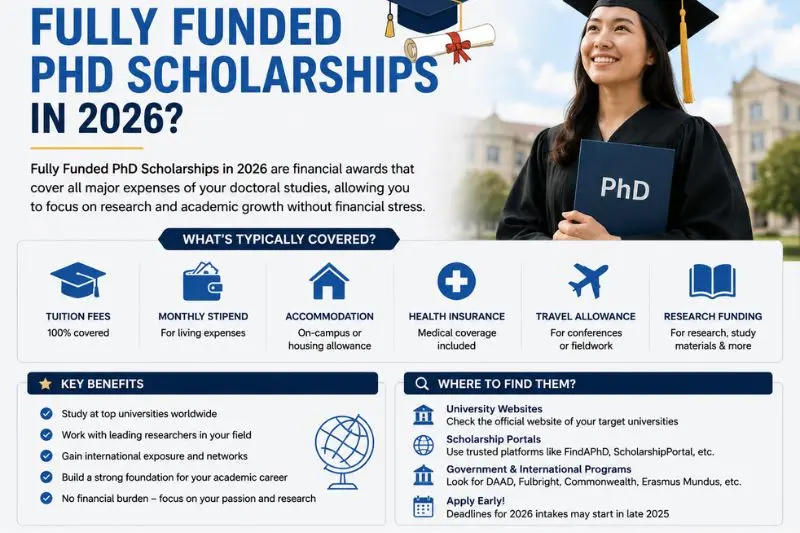
Fully Funded PhD Scholarships in 2026 are financial aid programs that cover the complete cost of pursuing a doctoral degree. Unlike partial scholarships that only reduce tuition fees, fully funded scholarships typically provide comprehensive financial support throughout the duration of the PhD program.
These scholarships commonly include:
- Full tuition fee coverage
- Monthly living stipend
- Research funding
- Health insurance
- Travel allowances
- Conference participation support
- Accommodation assistance in some cases
Funding may come from:
- Governments
- Universities
- Research institutions
- International organizations
- Private foundations
- Industry-sponsored research projects
The primary goal of these scholarships is to enable talented students to focus entirely on research and academic development without financial stress.
Why is Fully Funded PhD Scholarships in 2026 Important?
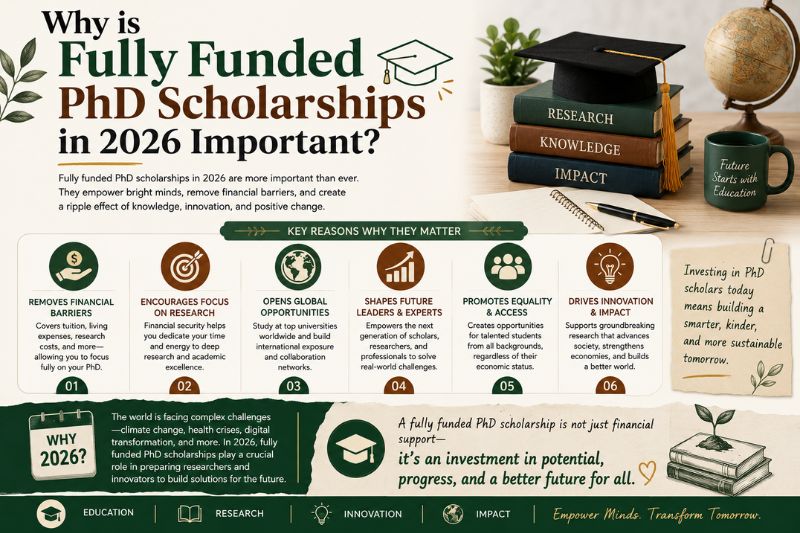
Fully funded doctoral opportunities are becoming increasingly important in today’s competitive academic environment.
First, they make higher education accessible to deserving students regardless of their financial background. Many talented individuals would otherwise be unable to pursue doctoral studies due to high costs.
Second, scholarships support innovation and research advancement. Universities and governments recognize that investing in researchers contributes to scientific breakthroughs, technological development, and social progress.
Third, scholarship recipients gain access to world-class facilities, experienced supervisors, and international academic networks. These opportunities often lead to stronger career prospects and professional growth.
Additionally, funded PhD programs help students avoid significant debt. Graduates can begin their careers with financial stability instead of years of loan repayments.
Finally, international scholarship programs encourage cultural exchange and global collaboration, creating diverse research communities that benefit everyone involved.
Detailed Step-by-Step Guide
Step 1: Identify Your Research Interests
Before applying for any scholarship, clearly define your research interests and academic goals.
Ask yourself:
- What subject am I passionate about?
- Which research problems interest me?
- What career path do I want after graduation?
A clear research focus helps you find suitable programs and supervisors.
Step 2: Research Available Scholarships
Start searching early because many scholarship deadlines occur months before program commencement.
Look for:
- Government scholarships
- University-funded scholarships
- Research council funding
- Foundation grants
- Industry-sponsored programs
Create a spreadsheet to track application deadlines, requirements, and eligibility criteria.
Step 3: Check Eligibility Requirements
Each scholarship has specific eligibility conditions.
Common requirements include:
- Bachelor’s and master’s degrees
- Strong academic performance
- Research experience
- Language proficiency
- Recommendation letters
- Research proposal
Carefully review every requirement before investing time in an application.
Step 4: Prepare Academic Documents
Gather all necessary documents well in advance.
Typical documents include:
- Academic transcripts
- Degree certificates
- Curriculum vitae
- Statement of purpose
- Research proposal
- Language test scores
- Passport copy
Ensure all documents are accurate and professionally formatted.
Step 5: Develop a Strong Research Proposal
A research proposal is often the most important component of your application.
Your proposal should include:
- Research topic
- Objectives
- Research questions
- Literature review
- Methodology
- Expected outcomes
- Significance of the study
A clear and realistic proposal demonstrates your readiness for doctoral research.
Step 6: Contact Potential Supervisors
Many universities require applicants to secure supervisor approval before admission.
When contacting professors:
- Introduce yourself professionally
- Mention your academic background
- Explain your research interests
- Attach your CV
- Include a concise research summary
Personalized communication often receives better responses.
Step 7: Obtain Strong Recommendation Letters
Recommendation letters provide insight into your academic abilities and research potential.
Choose referees who:
- Know your work well
- Have supervised your projects
- Can discuss your strengths in detail
Give referees sufficient time to prepare thoughtful recommendations.
Step 8: Demonstrate Language Proficiency
International students may need English language test scores.
Common tests include:
- IELTS
- TOEFL
- PTE Academic
Some universities waive these requirements under specific conditions, so always verify institutional policies.
Step 9: Submit Applications Carefully
Before submission:
- Review every document
- Check formatting requirements
- Confirm deadline dates
- Verify uploaded files
Even minor mistakes can negatively affect your application.
Step 10: Prepare for Interviews
Some scholarship programs conduct interviews.
Interview preparation tips:
- Review your research proposal
- Understand your chosen field
- Practice answering common questions
- Demonstrate enthusiasm and confidence
Strong interview performance can significantly improve your chances of success.
Step 11: Follow Up Professionally
After submission, monitor application updates and email communications regularly.
Respond promptly to:
- Additional document requests
- Interview invitations
- Clarification questions
Professional communication leaves a positive impression.
Step 12: Evaluate Scholarship Offers
If you receive multiple offers, compare:
- Funding amount
- Research facilities
- Supervisor expertise
- University reputation
- Career opportunities
- Location and living conditions
Choose the option that best aligns with your long-term goals.
Benefits of Fully Funded PhD Scholarships in 2026
The advantages of securing a fully funded scholarship are substantial.
- Complete tuition fee coverage
- Monthly financial support
- Reduced financial stress
- Access to world-class research facilities
- Opportunities for international collaboration
- Conference participation funding
- Professional networking opportunities
- Enhanced academic reputation
- Improved employment prospects
- Access to experienced supervisors
- Research publication support
- Exposure to diverse cultures
- Increased focus on academic excellence
- Better work-life balance compared to self-funded study
- Greater freedom to pursue innovative research topics
These benefits allow students to maximize their academic and professional potential.
Disadvantages / Risks
Although highly beneficial, funded PhD programs also present certain challenges.
- Extremely competitive selection processes
- High academic performance expectations
- Strict research milestones
- Limited flexibility in some funded projects
- Pressure to publish research findings
- Potential relocation challenges
- Cultural adjustment difficulties
- Visa and immigration complexities
- Intensive workload requirements
- Long program duration
Understanding these challenges helps students prepare realistically for doctoral studies.
Common Mistakes to Avoid
Many applicants weaken their chances through avoidable errors.
Applying Without Researching Requirements
Every scholarship differs. Generic applications often fail because they do not meet specific expectations.
Writing Weak Research Proposals
A poorly structured proposal can quickly eliminate an otherwise strong candidate.
Missing Deadlines
Late applications are typically rejected automatically.
Ignoring Supervisor Communication
Failing to engage with potential supervisors may reduce your admission chances.
Using Generic Statements
Personal statements should be tailored to each scholarship and institution.
Choosing Referees Poorly
Weak recommendation letters can undermine your application.
Neglecting Proofreading
Grammar errors, formatting mistakes, and inconsistencies create an unprofessional impression.
Applying to Too Few Programs
Limiting applications reduces your chances of receiving funding.
Underestimating Interviews
Interview preparation is essential. Strong applicants sometimes lose opportunities due to poor interview performance.
Failing to Demonstrate Research Potential
Selection committees seek evidence of curiosity, critical thinking, and academic commitment.
What are Fully Funded PhD Scholarships in 2026?
These are scholarship programs that cover tuition fees and provide financial support for living expenses, research activities, and other educational costs throughout a doctoral degree.
Who can apply for fully funded PhD scholarships?
Eligibility varies by program, but applicants generally need strong academic records, relevant qualifications, research interests, and supporting documents.
Are fully funded scholarships available for international students?
Yes. Many universities and governments specifically encourage international applications and offer funding opportunities to students worldwide.
Do I need a master’s degree before applying?
In most cases, a master’s degree is preferred or required. However, some universities allow exceptional students to enter PhD programs directly after completing a bachelor’s degree.
How competitive are fully funded PhD scholarships?
These scholarships are highly competitive because they offer comprehensive financial support and attract talented candidates from around the world.
What GPA is usually required?
Requirements vary, but successful applicants generally possess strong academic records and demonstrate consistent excellence throughout their studies.
How long does a funded PhD program last?
Most PhD programs last between three and five years, depending on the country, discipline, and research project.
Can scholarship recipients work while studying?
Many programs allow limited part-time work, but students should review scholarship conditions carefully to avoid violating funding agreements.
Expert Tips & Bonus Points
Securing Fully Funded PhD Scholarships in 2026 requires more than academic excellence. Strategic preparation can significantly improve outcomes.
Start planning at least one year before application deadlines. Early preparation provides sufficient time to improve qualifications, develop research proposals, and identify suitable supervisors.
Build research experience whenever possible. Publications, conference presentations, research assistantships, and independent projects strengthen your academic profile.
Network with professors and researchers in your field. Professional relationships often provide valuable guidance and scholarship recommendations.
Customize every application. Scholarship committees appreciate candidates who demonstrate genuine interest in specific programs.
Maintain an updated academic CV that highlights achievements, skills, awards, and research contributions.
Practice explaining your research clearly and confidently. Strong communication skills are essential during interviews and supervisor interactions.
Apply broadly while remaining strategic. A balanced application portfolio increases opportunities without sacrificing quality.
Stay organized throughout the process by tracking deadlines, requirements, and application progress.
Finally, remain persistent. Many successful PhD scholars received rejections before securing funding. Continuous improvement often leads to eventual success.
Conclusion
Fully Funded PhD Scholarships in 2026 represent one of the most valuable opportunities available to aspiring researchers and academics. By eliminating financial barriers, these scholarships enable talented individuals to focus on advanced study, innovative research, and professional development. They provide comprehensive support that often includes tuition coverage, living stipends, research funding, health insurance, and international networking opportunities.
However, securing funding requires careful preparation, strategic planning, and strong academic credentials. Applicants must identify suitable programs, develop compelling research proposals, establish relationships with potential supervisors, and submit high-quality applications that clearly demonstrate their research potential. Attention to detail throughout the process can significantly improve the likelihood of success.
Although competition remains intense, thousands of students secure fully funded doctoral opportunities every year through persistence, preparation, and dedication. Understanding scholarship requirements, avoiding common mistakes, and implementing expert strategies can give applicants a meaningful advantage.
For students who dream of contributing to knowledge, solving complex problems, and building rewarding academic or professional careers, Fully Funded PhD Scholarships in 2026 offer an exceptional pathway forward. With determination, strong preparation, and a commitment to excellence, aspiring researchers can transform their educational ambitions into reality and pursue doctoral studies at leading institutions around the world.
