


Introduction
Success rarely happens by accident. Behind every achievement, there is usually one powerful trait working quietly in the background: self-discipline. Whether you want to study better, improve your health, grow your career, or build better habits, learning how to build self-discipline can completely change your life.
Many people think discipline means being strict, harsh, or forcing yourself to suffer. That is not true. Real discipline is about making good choices even when you do not feel motivated. It means staying committed to your goals when distractions appear.
The good news is that discipline is not something people are born with. It is a skill. Like strength in the gym, it becomes stronger with practice. Even if you struggle with procrastination, laziness, or inconsistency today, you can improve.
In modern life, distractions are everywhere. Social media, endless entertainment, and poor routines make it easy to lose focus. That is why understanding how to build self-discipline is more important than ever.
This guide will help beginners and intermediate learners develop discipline in a practical way. You will learn what self-discipline is, why it matters, common mistakes to avoid, and step-by-step methods to build strong habits that last.
If you are ready to take control of your life, this guide will show you exactly where to begin.
What is Self-Discipline?
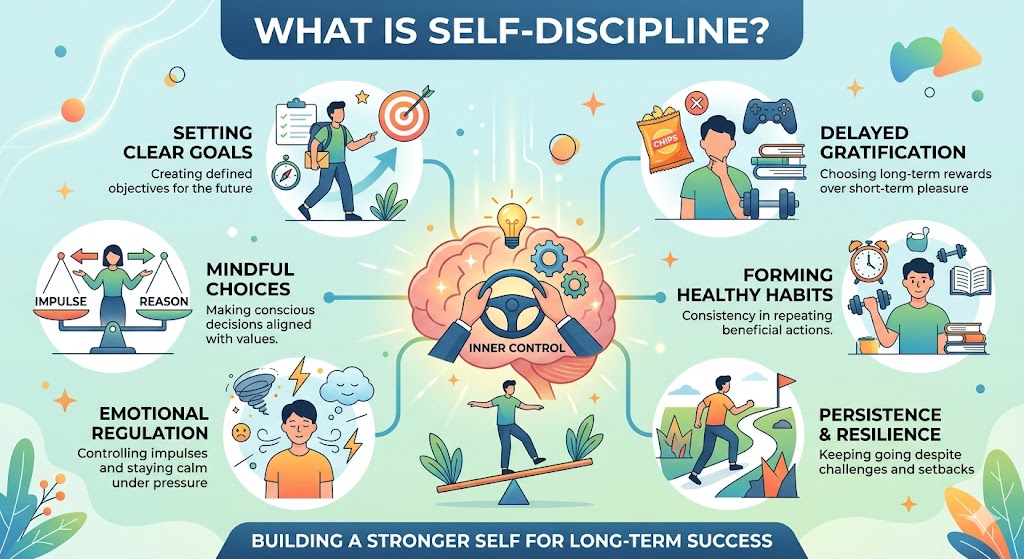
Self-discipline is the ability to control your thoughts, emotions, and actions so you can stay focused on long-term goals.
In simple words, it means doing what needs to be done, even when you do not feel like doing it.
For example:
- Studying instead of scrolling social media
- Saving money instead of spending impulsively
- Exercising even when feeling lazy
- Finishing work before relaxing
Self-discipline is not about perfection. It is about consistency.
Motivation comes and goes. Some days you feel excited. Other days you feel tired. Discipline helps you continue even when motivation disappears.
People often confuse discipline with punishment. In reality, discipline creates freedom. When you control your habits, your habits stop controlling you.
That is the true power behind learning how to build self-discipline.
Why is Self-Discipline Important?
Self-discipline affects nearly every area of life.
Without discipline, even talented people struggle. With discipline, average people often outperform naturally gifted people.
Here are key reasons why self-discipline matters.
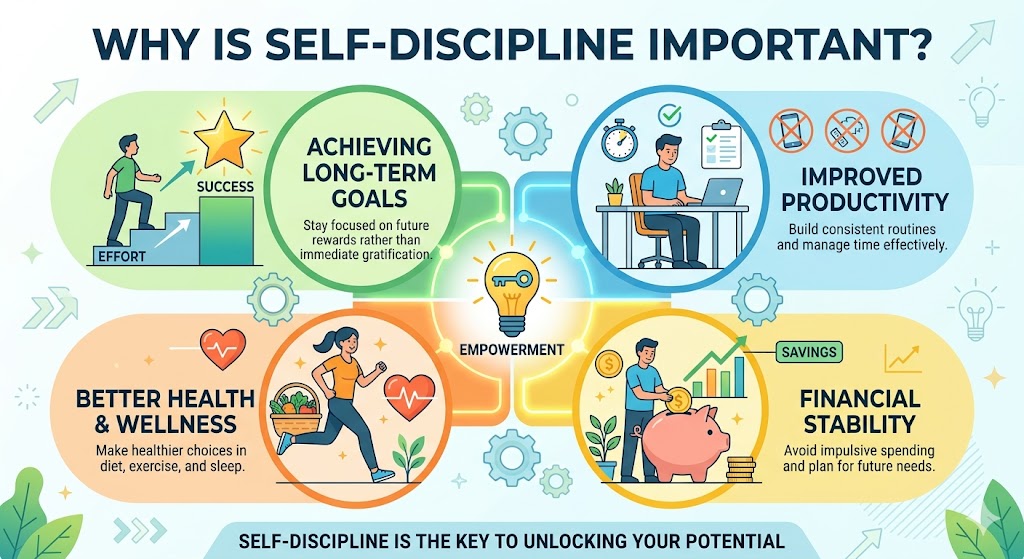
It Improves Productivity
They prioritize important tasks and finish work faster.
Disciplined people waste less time.
It Builds Better Habits
Habits shape daily life.
Discipline helps you repeat positive behaviors until they become automatic.
It Reduces Stress
Last-minute work creates pressure.
When you stay disciplined, you avoid unnecessary stress.
It Increases Confidence
Every time you keep a promise to yourself, confidence grows.
You begin trusting yourself more.
It Leads to Long-Term Success
Big goals are achieved through small daily actions.
Discipline makes those actions possible.
That is why understanding how to build self-discipline is one of the most valuable life skills you can develop.
Detailed Step-by-Step Guide
Step 1: Define Clear Goals
Discipline becomes easier when you know exactly what you want.
Vague goals create confusion.
Bad goal:
“I want to be successful.”
Better goal:
“I will study coding for 45 minutes daily.”
Specific goals create direction.
Ask yourself:
What do I want?
Why do I want it?
What action moves me forward daily?
Clear goals strengthen discipline.
Step 2: Start Small
Many people fail because they start too big.
They try extreme changes overnight.
Examples:
- Workout 2 hours daily
- Read 100 pages daily
- Wake up at 4 AM immediately
This often leads to burnout.
Instead, start small.
Examples:
- 10 push-ups
- 5 pages reading
- 15 minutes focused work
Small wins create momentum.
This is one of the most practical lessons in how to build self-discipline.
Step 3: Build a Routine
Routines reduce decision fatigue.
When actions become scheduled, discipline requires less mental energy.
Example morning routine:
- Wake up
- Drink water
- Exercise
- Plan the day
Example study routine:
- Same place
- Same time
- Same focus session
Routine turns effort into habit.
The less you rely on mood, the stronger your discipline becomes.
Step 4: Remove Distractions
Environment shapes behavior.
If distractions surround you, discipline becomes harder.
Common distractions:
- Phone notifications
- Social media
- Loud surroundings
- Unplanned breaks
Reduce temptation.
Practical methods:
- Put phone away
- Block distracting apps
- Keep workspace clean
- Use focus timers
Strong discipline often starts with smart environments.
Step 5: Master Delayed Gratification
This means choosing long-term reward over short-term pleasure.
Example:
Short-term pleasure:
Watching videos for hours.
Long-term reward:
Learning a valuable skill.
Disciplined people ask:
“What helps future me?”
This mindset changes decisions.
Learning delayed gratification is essential in mastering how to build self-discipline.
Step 6: Track Your Progress
What gets measured gets improved.
Tracking creates awareness.
You can track:
- Workout days
- Study hours
- Reading progress
- Savings
Use:
- Journal
- Calendar
- Habit tracker
When progress becomes visible, motivation improves.
Even small progress matters.
Step 7: Strengthen Mental Toughness
Discipline becomes stronger when you learn to tolerate discomfort.
Sometimes you will feel:
- Bored
- Tired
- Frustrated
- Unmotivated
That is normal.
Do not quit because feelings change.
Train yourself to act despite discomfort.
Mental toughness grows every time you choose action over excuses.
Step 8: Control Your Self-Talk
Your inner voice matters.
Negative thoughts weaken discipline.
Examples:
- “I always fail.”
- “I am too lazy.”
- “I cannot do this.”
Replace them with stronger thoughts.
Examples:
- “I am improving daily.”
- “I can stay consistent.”
- “One step at a time.”
Words influence behavior.
Strong self-talk supports disciplined action.
Step 9: Reward Consistency
Rewards reinforce habits.
But reward effort, not laziness.
Example:
After 7 study sessions, enjoy a movie.
After finishing workouts all week, take a relaxing break.
Rewards help the brain associate discipline with positive outcomes.
Use rewards wisely.
Step 10: Accept Imperfection
Nobody stays perfect every day.
You will miss days.
That is okay.
One bad day does not destroy progress.
The real danger is giving up completely.
Follow this rule:
Never miss twice.
If you skip today, restart tomorrow.
This mindset makes how to build self-discipline sustainable long-term.
Benefits of Self-Discipline
Self-discipline offers powerful life-changing benefits.
- Better time management
- Improved focus and concentration
- Higher productivity
- Stronger emotional control
- Better financial habits
- Healthier lifestyle
- Reduced procrastination
- More confidence
- Greater resilience
- Faster personal growth
Disciplined people often feel more in control of life.
They react less emotionally and make smarter decisions.
Over time, the gap between disciplined and undisciplined people becomes huge.
Small daily choices create big life differences.
Disadvantages / Risks
Although discipline is powerful, unhealthy discipline can create problems.
Be aware of these risks.
- Becoming too rigid
- Ignoring rest and recovery
- Feeling guilty after small mistakes
- Developing perfectionism
- Burnout from unrealistic standards
- Losing flexibility in life
Balance matters.
Healthy discipline includes rest.
Rest is not laziness.
Recovery improves performance.
Use discipline wisely.
Common Mistakes to Avoid
Many people fail not because discipline is impossible, but because they make avoidable mistakes.
Depending Only on Motivation
Motivation feels great but disappears quickly.
Discipline must work even on low-energy days.
Setting Unrealistic Goals
Huge goals can feel exciting.
But they often become overwhelming.
Start manageable.
Expecting Fast Results
Real change takes time.
Patience matters.
Daily improvement compounds.
Trying to Change Everything at Once
Too many changes create stress.
Focus on one habit first.
Then expand.
Being Too Hard on Yourself
Self-criticism kills progress.
Learn from mistakes instead.
Growth requires patience.
Ignoring Sleep and Health
Low energy weakens discipline.
Sleep, food, and movement matter.
Physical health supports mental strength.
Avoiding these mistakes makes learning how to build self-discipline much easier.
Can self-discipline be learned?
Yes.
Self-discipline is a trainable skill.
No one starts perfect.
Small repeated actions build discipline over time.
The more consistently you practice, the stronger it becomes.
How long does it take to build discipline?
There is no fixed timeline.
Some habits form in weeks.
Others take months.
What matters most is consistency.
Progress depends on effort, environment, and habit difficulty.
What is the difference between discipline and motivation?
Motivation is temporary excitement.
Discipline is consistent action.
Motivation helps you start.
Discipline helps you continue.
Long-term success depends more on discipline.
Why do I lose discipline so quickly?
Common reasons include:
Unrealistic goals
Poor environment
Lack of sleep
Too many distractions
No clear purpose
Identify what weakens your consistency.
Then fix it.
How do I stop procrastinating?
Break tasks into smaller steps.
Large tasks feel intimidating.
Small tasks feel manageable.
Use a simple rule:
Start for 5 minutes.
Often, starting is the hardest part.
Action creates momentum.
Can discipline improve confidence?
Absolutely.
Every time you follow through, trust in yourself grows.
Confidence is built through action.
Keeping promises to yourself strengthens self-respect.
That confidence affects every part of life.
Expert Tips & Bonus Points
Here are advanced tips to accelerate progress.
Use the 5-Minute Rule
Tell yourself:
“I only need to do this for 5 minutes.”
This reduces resistance.
Once started, continuing becomes easier.
Prepare the Night Before
Reduce morning decisions.
Examples:
- Prepare clothes
- Make task list
- Organize desk
Preparation improves consistency.
Use Identity-Based Habits
Instead of saying:
“I want to exercise.”
Say:
“I am someone who trains regularly.”
Identity shapes behavior.
Become the type of person who naturally acts with discipline.
Practice Saying No
Discipline often means rejecting distractions.
Say no to:
Unnecessary scrolling
Time-wasting activities
Bad influences
Protect your focus.
Keep Promises to Yourself
This is powerful.
Every broken promise weakens self-trust.
Every kept promise strengthens discipline.
Start with small promises.
Keep them.
Surround Yourself with Disciplined People
Environment influences mindset.
If people around you are focused and consistent, you naturally improve.
Choose influences carefully.
Focus on Systems, Not Just Goals
Goals show destination.
Systems create results.
Example goal:
Lose 10 kg.
System:
Exercise daily and eat better.
Systems produce long-term success.
This is one of the strongest principles in how to build self-discipline.
Conclusion
Learning how to build self-discipline is one of the most important investments you can make in yourself. It affects your health, productivity, confidence, relationships, and future success. While talent and intelligence matter, discipline often determines who actually achieves meaningful results.
The journey is not about becoming perfect. It is about becoming consistent. Some days will feel easy. Other days will feel difficult. That is normal. What matters most is continuing forward.
Remember, discipline grows through small repeated actions. You do not need dramatic changes to transform your life. Start with one habit. Make one better decision today. Then repeat tomorrow.
Clear goals, strong routines, fewer distractions, and better self-control create lasting progress. Over time, these small actions compound into massive results.
There will be setbacks. You may fail, skip routines, or lose focus occasionally. That does not mean you failed permanently. It simply means you are human. Restart quickly and keep going.
The person you become through discipline matters even more than the goals you achieve. With patience and consistent effort, self-discipline becomes part of your identity.
Start today. Even one disciplined action can begin changing your future.
