


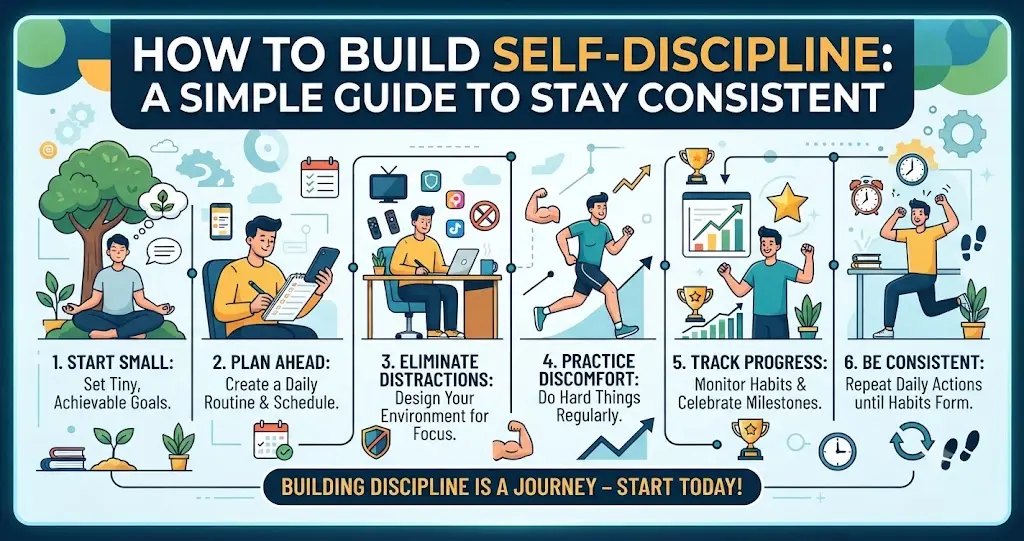
Self-discipline is one of the most powerful skills you can develop in life. It helps you stay focused, avoid distractions, and keep moving toward your goals even when motivation disappears. Many people think discipline is something you are born with, but that is not true. Anyone can learn it with practice and patience.
Introduction
If you want to know how to build self-discipline, the good news is that you do not need to become perfect overnight. Small daily actions can create huge long-term results. Discipline grows when you repeatedly choose what matters most over what feels easy right now.
Whether you want better study habits, improved health, stronger focus, or career success, self-discipline can change everything. It helps you control your actions instead of letting emotions control you.
In this guide, you will learn practical strategies, common mistakes, benefits, risks, and expert tips. The steps are simple, realistic, and beginner friendly. By the end, you will understand exactly how to build self-discipline and make it part of your daily life.
What is Self-Discipline?
Self-discipline is the ability to control your thoughts, emotions, and actions so you can do what needs to be done, even when you do not feel like doing it.
In simple words, discipline means choosing long-term rewards over short-term comfort.
For example, studying instead of scrolling social media is self-discipline. Going to the gym when you feel lazy is self-discipline. Saving money instead of buying unnecessary things is also self-discipline.
Discipline is not about being harsh with yourself. It is about creating habits and routines that support your goals.
People often confuse motivation and discipline. Motivation comes and goes. Discipline stays and keeps you moving.
Why is Self-Discipline Important?
Self-discipline matters because success usually comes from consistent action, not occasional effort.
Without discipline, people often start strong but quit when things become difficult.
Here is why discipline matters:
- It improves focus and productivity.
- It reduces procrastination.
- It builds confidence and self-trust.
- It helps you reach personal and professional goals.
- It creates mental strength during hard times.
When you learn how to build self-discipline, you become more reliable. You stop depending only on mood and start acting with purpose.
Detailed Step-by-Step Guide
Step 1: Know Your Why
Discipline becomes easier when your reason is clear.
Ask yourself why your goal matters. Do you want better grades? Better health? Financial freedom? More confidence?
A strong reason gives you power during difficult moments.
Write your reason on paper and read it daily.
Step 2: Start Small
One major mistake is trying to change everything at once.
Big changes feel exciting at first, but they often fail.
Start with small actions.
Examples:
- Read five pages daily.
Exercise for ten minutes.
Wake up fifteen minutes earlier. - Small wins build momentum.
Step 3: Create Clear Goals
Vague goals create vague results.
Instead of saying, “I want success,” define exactly what success means.
Good goals are specific and measurable.
Example:
Bad goal: I want to get fit.
Good goal: I will walk thirty minutes five days a week.
Clear goals make action easier.
Step 4: Build Daily Routines
- Routines reduce decision fatigue.
- When actions become part of your schedule, they require less mental energy.
- Create morning and evening routines.
- A simple morning routine may include:
- Wake up
- Drink water
- Stretch
- Plan your day
Daily routines are powerful tools for anyone learning how to build self-discipline.
Step 5: Remove Distractions
Distractions destroy focus.
Your environment shapes behavior more than you think.
If your phone distracts you, keep it away while working.
If junk food causes unhealthy eating, do not keep it nearby.
Make good habits easy and bad habits harder.
Step 6: Practice Delayed Gratification
Delayed gratification means resisting immediate pleasure for a better future reward.
This is a core part of discipline.
For example:
- Save money instead of impulsive shopping.
- Finish work before gaming.
- Study before entertainment.
The more you practice this skill, the stronger your discipline becomes.
Step 7: Track Progress
- What gets tracked gets improved.
- Keep a journal, checklist, or habit tracker.
- Mark each successful day.
- Tracking helps you see progress and stay motivated.
- Even small progress matters.
- Step 8: Accept Discomfort
- Growth feels uncomfortable.
- Many people quit because discipline feels hard.
- That discomfort is normal.
- Being tired, bored, or tempted does not mean you should stop.
- Learning how to build self-discipline means becoming comfortable with temporary discomfort.
- Step 9: Stay Consistent
- Consistency beats intensity.
- Doing something small every day is better than doing something huge once.
- For example, twenty minutes of study daily beats five hours once a week.
- Success comes from repeated effort.
Protect consistency.
Step 8: Recover After Failure
- You will fail sometimes.
- Everyone does.
- Missing one day does not ruin progress. Giving up does.
- If you slip, restart immediately.
- Avoid the all-or-nothing mindset.
- Progress matters more than perfection.
Here is a practical example. Imagine a student preparing for exams. At first, studying three hours daily feels impossible. Instead of forcing that schedule immediately, the student begins with twenty minutes each evening. After one week, twenty minutes becomes normal. Then the student increases to forty minutes. Slowly, discipline grows without overwhelming pressure.
This example shows something important. Discipline grows through repetition, not pressure. People often fail because they demand instant transformation. Real change usually happens gradually.
Another useful strategy is habit stacking. Habit stacking means attaching a new habit to an existing habit. This makes consistency easier because you already have a stable trigger.
For example:
- After brushing your teeth, review your goals.
- After breakfast, read for ten minutes.
- After dinner, plan tomorrow.
This method reduces friction and improves follow through.
You should also understand the role of emotions. Many people believe disciplined people never feel tempted. That is false. Disciplined people feel the same temptations as everyone else. The difference is how they respond.
Instead of obeying every emotion, they pause and choose wisely.
For example, you may feel like skipping work because you feel bored. Discipline means noticing that feeling without letting it control your decision.
That mental pause is powerful.
Another key factor is self-awareness. Notice patterns in your daily behavior.
Ask yourself:
- When do I procrastinate most?
- What distractions hurt me?
- What triggers bad habits?
- When is my energy highest?
These answers help you design better routines.
Energy management matters more than many people realize. Discipline becomes easier when your body supports your goals.
Simple habits improve energy:
- Drink enough water
- Sleep well
- Move your body
- Eat balanced meals
When energy is low, even simple tasks feel difficult.
This is why health and discipline are connected.
Many beginners ask whether discipline removes freedom. Actually, healthy discipline creates freedom.
For example, financial discipline gives freedom from constant money stress. Study discipline creates career opportunities. Health discipline increases physical freedom and energy.
Short-term discipline often creates long-term freedom.
You should also build boundaries.
Boundaries protect your focus and time.
This may mean saying no to unnecessary plans, reducing screen time, or limiting social media.
- Every yes to distraction can become a no to progress.
- That is why boundaries matter.
- Another useful tool is visualization.
- Spend two minutes imagining your future self.
- Picture yourself healthier, stronger, calmer, and more successful.
- Then imagine the cost of staying undisciplined.
- This comparison can strengthen commitment.
- The brain responds strongly to clear mental pictures.
- You can also use rewards strategically.
- Rewards should support progress, not destroy it.
For example, after completing a study session, take a short relaxing break. After reaching a weekly goal, enjoy something meaningful.
- Rewards help the brain connect effort with positive feelings.
- Still, avoid rewarding yourself in ways that sabotage your goal.
- Mindset matters greatly in discipline.
- If you believe discipline is punishment, you will resist it.
- Instead, see discipline as self-respect.
- Every disciplined action sends a message to yourself.
It says:
- I keep promises to myself.
- I value my future.
- I am capable of growth.
This mindset creates confidence.
Confidence and discipline strengthen each other.
The more disciplined actions you take, the more confidence you build.
The more confidence you build, the easier disciplined action becomes.
This creates a positive cycle.
However, negative self-talk creates the opposite cycle.
Saying things like “I am lazy” or “I always fail” weakens effort.
Replace those thoughts with better ones.
Try:
- I am improving daily.
- I can restart anytime.
- One action matters.
These statements encourage action.
Discipline also improves decision making.
When your values are clear, decisions become simpler.
For example, if health is a top priority, choosing healthy food becomes easier.
If learning is a priority, protecting study time becomes natural.
Values guide discipline.
Parents can also teach discipline to children through routines and consistency. Students benefit from disciplined schedules. Workers benefit from disciplined time management. Entrepreneurs need discipline to handle uncertainty.
In other words, discipline helps people in every stage of life.
Social circles also affect discipline.
The people around you influence your habits.
If you spend time with focused, responsible people, their behavior can inspire you.
If your environment encourages distraction, discipline becomes harder.
Choose company that supports growth.
This does not mean avoiding everyone. It means being intentional.
Sometimes technology helps discipline.
Useful tools include:
- Timers
- Calendar reminders
- Focus apps
- Habit trackers
- Website blockers
Use technology to reduce distractions instead of increasing them.
Morning discipline is especially valuable.
The first hour of your day often shapes the rest.
If you wake up and immediately scroll social media, focus may decrease.
If you start with purpose, the day feels more controlled.
A strong morning can include planning, movement, and quiet focus.
Night routines matter too.
A chaotic evening often creates a messy morning.
Before sleeping:
- Prepare clothes
- Set priorities
- Limit screens
- Sleep on time
Preparation reduces next-day resistance.
Another important lesson is patience.
Many people quit because results feel slow.
Discipline does not always produce immediate visible rewards.
Sometimes progress stays hidden for weeks.
Then suddenly results become obvious.
Trust the process.
Think of planting seeds.
You water the seed daily, but growth is not visible immediately.
Discipline works the same way.
Eventually, consistent effort produces visible results.
That is why patience is essential.
Perfectionism is another hidden enemy.
Perfectionists often delay action because they fear mistakes.
But discipline grows through imperfect action.
Doing something imperfectly is better than doing nothing.
Start messy.
Improve later.
Action creates clarity.
You can also create consequences.
Consequences increase accountability.
For example, promise a friend you will complete a goal. If you fail, donate money or lose a privilege.
This adds pressure in a useful way.
Still, consequences should motivate, not shame.
Shame usually reduces progress.
Compassion matters too.
Being disciplined does not mean becoming emotionless.
You can be kind and accountable at the same time.
If you fail, analyze instead of attacking yourself.
Ask:
What happened?
What triggered this?
What can I improve?
This approach leads to growth.
Reflection accelerates discipline.
Spend five minutes weekly reviewing progress.
Ask:
- What worked?
- What failed?
- What should change?
Small adjustments create better systems.
Systems matter more than goals alone.
Goals tell you where to go.
Systems determine whether you arrive.
For example, wanting to write a book is a goal.
Writing five hundred words daily is a system.
Strong systems make success more likely.
Finally, remember that discipline is personal.
Your routine does not need to look like someone else’s routine.
Some people work best early. Others focus better later.
Build a system that fits your reality.
The best discipline system is the one you can sustain.
- Keep it realistic.
- Keep it simple.
- Keep going.
Benefits of Self-Discipline
Self-discipline offers many life-changing benefits:
- Better time management
- Improved focus
- Higher productivity
- Stronger confidence
- Better health habits
- More emotional control
- Reduced stress
- Increased financial control
- Stronger relationships
- Greater success in long-term goals
People with discipline often feel more in control of their lives.
Disadvantages / Risks
Discipline is powerful, but too much rigidity can create problems.
Possible risks include:
Becoming overly strict with yourself
Feeling guilty after small mistakes
Ignoring rest and recovery
Burnout from unrealistic expectations
Losing flexibility in daily life
Healthy discipline includes balance.
Rest is not weakness. Recovery supports consistency.
Common Mistakes to Avoid
Many people struggle because they repeat common mistakes.
First, relying only on motivation is dangerous. Motivation changes daily.
Second, setting unrealistic goals leads to frustration.
Third, trying to become perfect creates pressure.
Fourth, comparing yourself with others damages confidence.
Fifth, quitting after failure stops progress.
Another mistake is ignoring sleep, nutrition, and energy. Discipline becomes harder when your body is exhausted.
Avoid these mistakes to make progress faster.
Can anyone learn self-discipline?
Yes. Self-discipline is a skill, not a personality trait. Like muscles, it grows stronger with practice. Anyone can improve through repetition, routines, and better habits.
How long does it take to build self-discipline?
There is no fixed timeline. Some habits improve in weeks, while deeper discipline may take months or years. The key is consistency.
What if I feel lazy every day?
Laziness often comes from lack of clarity, low energy, or overwhelming goals. Start with tiny actions. Action usually creates motivation.
Is discipline more important than motivation?
Yes, in the long term. Motivation helps you start, but discipline helps you continue when motivation fades.
How do I stop procrastinating?
Break tasks into smaller steps. Remove distractions. Use time blocks. Start with just five minutes to overcome resistance.
Can self-discipline reduce stress?
Yes. Discipline improves planning, reduces last-minute pressure, and creates more control over daily responsibilities.
Expert Tips & Bonus Points
Here are extra tips to strengthen discipline faster.
Use the two-minute rule. If a task takes less than two minutes, do it immediately.
Reward progress. Small rewards help reinforce good habits.
Use accountability. Tell a friend about your goals.
Protect your sleep. Low energy weakens discipline.
Talk to yourself positively. Your inner voice affects behavior.
Celebrate consistency, not perfection.
Remember that identity matters. Instead of saying, “I am trying to be disciplined,” say, “I am a disciplined person.” Your actions often follow your identity.
One final idea is to measure identity based habits. Instead of only chasing results, ask what kind of person you want to become. Each action becomes a vote for that identity. Every workout is a vote for becoming healthy. Every study session is a vote for becoming knowledgeable. Every saved dollar is a vote for becoming financially responsible.
This perspective makes daily choices meaningful.
Discipline also improves emotional stability. When life becomes stressful, routines create structure. Structure reduces chaos. Even simple habits like making your bed or planning your tasks can create calm.
Remember that setbacks are part of growth. Holidays, illness, family issues, or unexpected events can interrupt routines. That does not erase progress. Return to basics and restart.
The strongest disciplined people are not those who never fail. They are the ones who recover quickly.
Keep a simple rule: never miss twice.
Missing once may happen. Missing twice starts a pattern.
Protect the next action.
This small rule prevents long breaks.
You can also create visual reminders around your environment. Sticky notes, written goals, and habit calendars keep priorities visible. When goals stay visible, distractions lose some power.
Most importantly, take ownership of your choices. Discipline grows when excuses shrink. Blaming time, weather, mood, or other people gives away control. Responsibility gives it back.
Say, I choose my actions.
That mindset creates lasting strength.
Remember, progress is rarely linear. Some weeks feel amazing. Some feel slow. Keep showing up anyway. Consistency during average days matters most.
Create checkpoints every month. Review habits, celebrate wins, and remove obstacles. Improvement becomes easier when you regularly adjust your plan.
Also, protect your attention like a valuable resource. Attention is limited. Where attention goes, energy follows. Use it wisely every single day.
Discipline is built in ordinary moments, not only dramatic ones. Choosing water over soda, reading instead of scrolling, or starting work on time may seem small, but repeated choices shape character and results.
Small choices become habits. Habits become lifestyle. Lifestyle shapes destiny. That is why daily discipline matters so much. Focus on today. Win this hour, then the next. Simple repeated wins create powerful transformation over time for every person.
Stay patient, stay consistent, and trust steady effort. Your future self will thank you for every disciplined choice you make starting right now, even when progress feels slow today for lasting meaningful success.
Conclusion
Learning how to build self-discipline can completely change your life. It helps you stay committed to your goals, even when motivation disappears. More importantly, discipline teaches you to trust yourself.
The journey does not require perfection. It requires awareness, effort, and consistency. Start with small habits. Build routines. Remove distractions. Accept discomfort. Keep going even after setbacks.
Some days will feel easy. Other days will feel difficult. That is normal. Discipline is built during difficult moments when you choose action over excuses.
Remember, success is rarely about doing something extraordinary once. It is about doing the right things repeatedly.
If you truly want to grow, start today. Pick one small habit and commit to it. Over time, that small action will become a strong habit, and that habit will shape your future.
Self-discipline is not about controlling every second of your life. It is about making better choices consistently. Master that skill, and you can achieve far more than you imagine.
